Electronic Visit Verification designed for caregiver reality
We build the software that runs a homecare agency end to end — GPS-verified visits, scheduling, care plans, billing and payroll in one system, with a caregiver app that keeps working when the signal drops.
- GPS, telephony and offline verification
- Built to work with your state aggregator
- Verified visit straight through to claim
Visit status
LIVE
GPS + offline
Scheduling
READY
Real-time
Documentation
E-SIGN
Audit history
Payroll & Billing
Live GPS
Caregiver Status
6
Core EVV data elements
3
Verification methods
10
Connected product modules
1
Agency-branded platform
What paper costs a homecare agency
Every one of these is a failure we have been called in to fix. They all trace back to the same thing: the record of a visit being created somewhere other than the visit.
Claims denied for unverified visits
A visit without a verifiable record is a visit a payer can refuse. Paper timesheets and after-the-fact data entry turn delivered care into unbillable care.
Missed visits found out too late
When a caregiver does not arrive, the office should know within minutes — not when a family calls, or when the timesheet arrives on Friday.
Payroll rebuilt by hand every cycle
Coordinators re-typing hours from paper into payroll is slow, and every keystroke is a chance to overpay, underpay or spark a dispute.
Audits that take weeks to answer
When a payer asks what happened on a visit eight months ago, the answer should take seconds to produce, with the trail attached.
Six things every visit has to prove
The 21st Century Cures Act requires Electronic Visit Verification to capture six data elements for Medicaid personal care and home health visits. The platform records all six at the point of care — not reconstructed afterwards.
Type of service
Which authorised service was delivered on the visit.
Individual receiving care
The client the service was delivered to.
Individual providing care
The caregiver who actually performed the visit.
Date of service
The calendar date the service was delivered.
Time it begins and ends
Captured at the point of care, not reconstructed later.
Location of service
Where care was delivered, verified at clock-in and clock-out.
One visit, start to finish
The same record carries through the whole chain, so what was scheduled, what was delivered, what gets billed and what gets paid can never quietly disagree.
Schedule
The visit is authorised and staffed. Conflicts, overtime risk and missing credentials are caught while the schedule is being built, not after.
Verify
The caregiver clocks in at the point of care. GPS, telephony or a fixed device records the six required elements, online or off.
Document
Tasks, notes, observations and signatures are captured against the care plan while the caregiver is still in the home.
Bill and pay
The verified visit becomes a claim-ready line and a payroll entry. No re-keying, and no gap between what was delivered and what is invoiced.
What the platform actually does
Ten modules, one system. Pick any of them to see what it covers — these are the real feature sets, not a summary.
Electronic Visit Verification
Every visit is captured at the point of care with the six data elements the Cures Act requires, then held with a full audit trail. Exceptions surface immediately instead of at the end of the billing cycle.
- GPS-verified clock-in and clock-out
- Telephony (IVR) verification from the client landline
- Fixed-device verification for homes with no signal
- Offline capture that syncs when the phone reconnects
- Geofence tolerance set per client
- Late, early and missed-visit alerts in real time
- Manual-edit reasons with a full change history
- Visit exception queue for coordinators
Scheduling and shift management
Build and fill the roster with the constraints already applied — authorised hours, caregiver skills, travel time and availability — so a schedule that saves is a schedule that can actually be worked.
- Drag-and-drop calendar by caregiver, client or team
- Recurring visit patterns and templates
- Double-booking and overtime warnings
- Availability and time-off requests from the app
- Skill, gender-preference and language matching
- Open-shift broadcast and claim
- Authorised-hours tracking against each client
- Instant notification of every schedule change
Caregiver and employee management
One record per caregiver holding everything a coordinator or auditor needs — credentials, documents, training, availability and history — with expiry warnings before a certificate lapses.
- Caregiver profiles with contact and emergency details
- Licence, certification and immunisation tracking
- Expiry alerts before a credential lapses
- Background-check and onboarding checklists
- Automated screening and onboarding workflows
- Document vault with version history
- Training records and competency sign-off
- Role-based access down to the field level
- Employment history and status changes
Client and care management
The care plan lives where the visit happens. Tasks flow to the caregiver app, get completed in the home, and come back attached to the visit record.
- Client records with authorisations and payer detail
- Care plans built from a task library
- Assessments and reassessments on a schedule
- Service authorisation and unit tracking
- Contacts, family access and communication log
- Client-specific instructions and hazards
- Admission, hold and discharge workflows
- Incident reporting with follow-up
Visit documentation and digital forms
Replace the paper pack. Forms are built to your agency's wording, completed on the phone, signed on the screen, and stored against the visit they belong to.
- Task completion checklists per care plan
- Visit notes and structured observations
- Electronic client and caregiver signatures
- Custom digital forms built to your templates
- Photo attachments where policy allows
- Required-field rules before a visit can close
- Supervisory review and sign-off
- Everything retrievable from the visit record
Billing and claims
Claims are generated from verified visits, not from a separate spreadsheet — so what you bill and what you delivered cannot drift apart.
- Claim generation from verified visits only
- Medicaid, managed-care and private-pay workflows
- Rate tables per payer, service and client
- Clearinghouse submission and remittance import
- Denial tracking with reason codes
- Private-pay invoicing and statements
- Unbilled and held-visit reporting
- Aggregator export in the required format
Payroll and timesheets
Timesheets assemble themselves from the visits already verified, with the rules your agency runs on applied before anyone reviews them.
- Timesheets built automatically from verified visits
- Overtime, holiday and differential rules
- Mileage and travel-time capture
- Approval workflow before export
- Export to your payroll provider
- Per-caregiver pay-rate history
- Reimbursements and deductions
- Pay-period locking and adjustments
Reporting and analytics
The numbers an administrator is asked for, ready before they are asked. Operational, financial and compliance reporting from the same verified data.
- Live operations dashboard
- On-time performance and missed-visit trends
- Revenue, unbilled and denial reporting
- Authorisation utilisation by client
- Caregiver productivity and retention
- Compliance and exception summaries
- Scheduled reports by email
- CSV and Excel export on every view
Secure document management
Agency, caregiver and client documents in one controlled place, with who-saw-what recorded — so an audit request is a search, not an excavation.
- Encrypted storage for every document type
- Per-role and per-record access rules
- Version history with restore
- Expiry tracking and renewal reminders
- Bulk upload and tagging
- Access logging on every file
- Retention rules per document class
- Export packs for audit responses
Administration, roles and audit trail
Who can see what is a decision your agency makes, and every consequential action is written down. Multi-office agencies get separation without a second system.
- Granular role and permission matrix
- Multi-office and multi-programme support
- Full audit log of every record change
- Login history and session control
- Configurable approval workflows
- Agency-wide settings and branding
- Data export and retention controls
- Sandbox environment for training
Because not every home is the same
Signal dies, phones break, and some clients have neither. A verification model that only works in ideal conditions is a model that quietly falls back to paper.
Mobile GPS
The default. The caregiver clocks in on their own phone and the location is verified against the client address, with a tolerance you set.
Telephony (IVR)
For caregivers without a smartphone. A call from the client's landline verifies presence without any hardware in the home.
Fixed device
For homes with no reliable signal. A small device in the residence issues codes that reconcile the visit when the caregiver is back in coverage.
A caregiver app that works where the work happens
Adoption is the whole game. If the app is slow, confusing or dies without signal, caregivers go back to paper and every downstream number stops being true. Ours is built offline-first and tested with real caregivers before launch.
Caregiver app
Field demo
Clock In
Sample visit · Client A
Today’s schedule
What your team actually looks at
The admin console and the caregiver app are designed together, so the same visit reads the same way in the office and in the home.
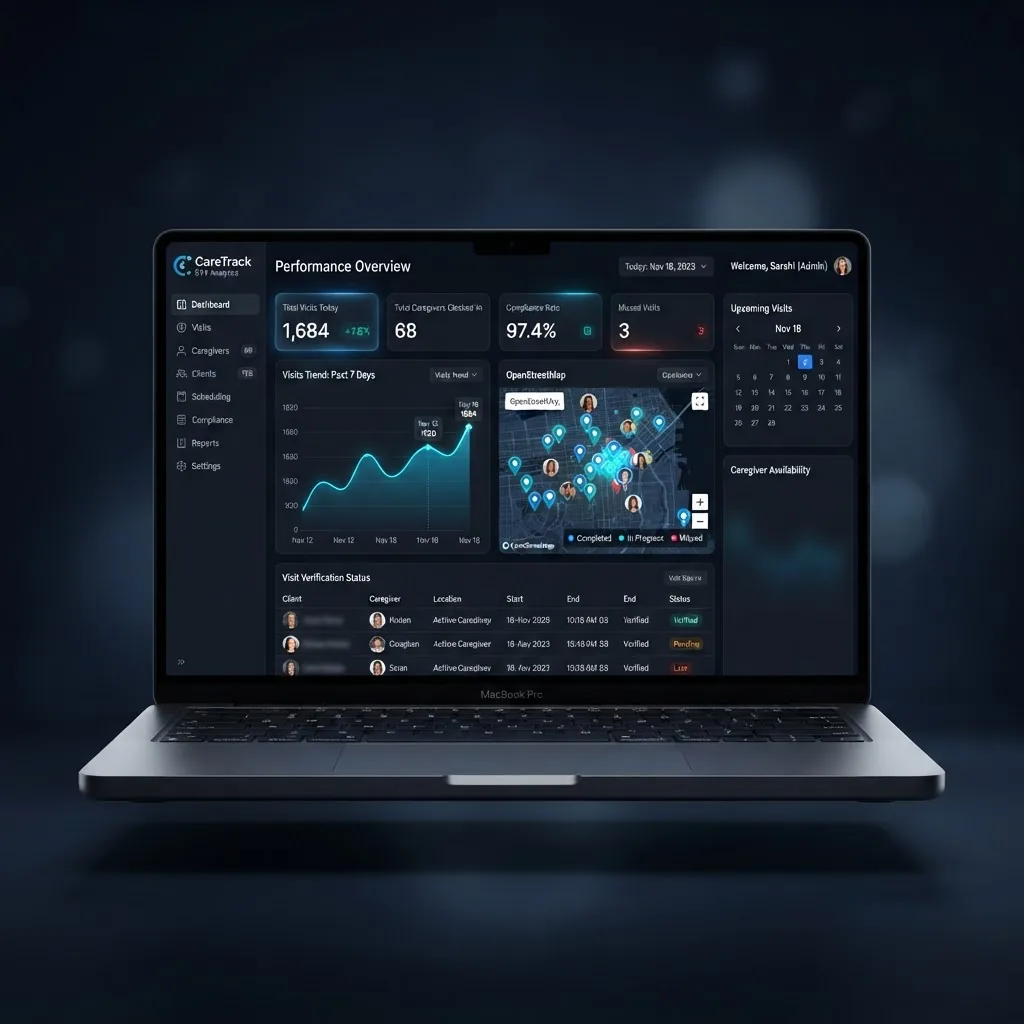
Operations console
Live visit status, exceptions and revenue on one screen.
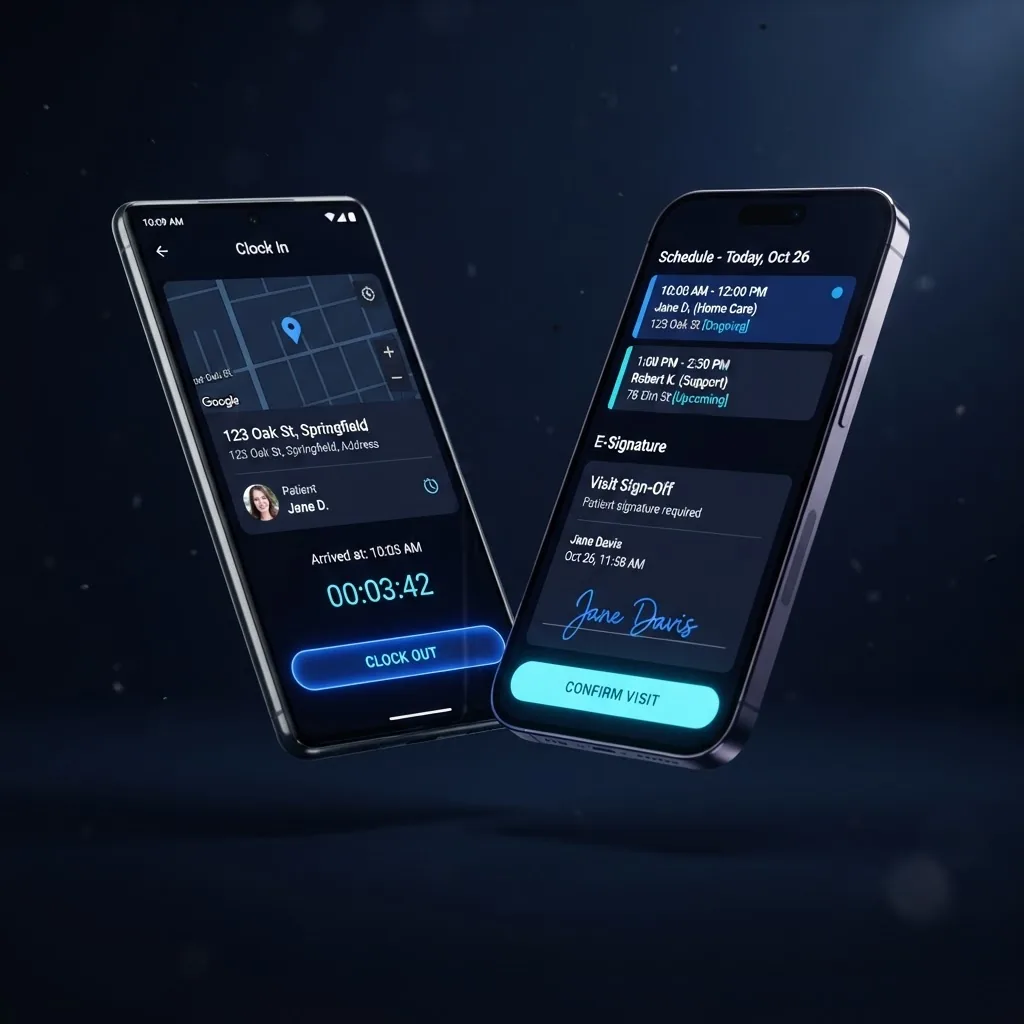
Caregiver app
Schedule, clock-in and care plan in the caregiver's hand.
Fits the systems you already answer to
Most agencies do not get to choose their state's model or their payer's format. We build to whichever applies to you — open model, state-mandated aggregator, or a mix across programmes.
EVV aggregators
Billing
Operations
Built for data people trust you with
Homecare records are among the most sensitive data a small business will ever hold. The platform is engineered on that assumption from the first commit.
HIPAA-aligned practices
Access control, audit logging and data handling designed around HIPAA safeguards, with a BAA in place where required.
Encrypted in transit and at rest
TLS everywhere, encrypted storage, and secrets held outside the application.
Least-privilege access
Roles scoped so a caregiver sees their own visits, a coordinator sees their office, and nobody sees more than their job needs.
A trail for every change
Who changed what, when and from where — retained so an audit question has an answer.
How a rollout actually runs
Replacing the system an agency bills through is not a weekend job. This is the path we run, and roughly what each stage takes.
Discovery
We sit with your coordinators and map how visits, billing and payroll work today — including the workarounds.
Design & build
Interfaces designed around your workflow, built in sprints with a working demo every week.
Data migration
Clients, caregivers, authorisations and history moved across and reconciled against your current system.
Pilot & training
A single office or team runs live while the rest keep working. Caregivers are trained on the app before they depend on it.
Go-live & support
Full cutover with hands-on cover through the first billing cycle, then SLA-backed support and a roadmap you help set.
The things agencies ask us first
The platform is built to capture the six data elements the Cures Act requires and to export in the format your state model expects, including submission to aggregators such as Sandata, HHAeXchange and Netsmart. What we do not do is certify compliance on your behalf — state programmes approve agencies, not vendors, so we build to your programme's published specification and support you through its testing process.
The app captures the visit offline and queues it. Location and timestamps are recorded on the device at the moment of care and sync when the phone reconnects, so the record reflects when the visit actually happened rather than when it uploaded. For homes with no coverage at all, telephony or a fixed device covers the gap.
Yes, and it is a planned phase rather than an afterthought. We move clients, caregivers, authorisations, care plans and the visit history you need to keep, then reconcile the result against your existing system before anyone relies on it.
On a custom build, yes — the deliverables produced for you are yours on full payment. We retain our own pre-existing frameworks and general know-how, which is what lets us start you further along than a blank repository.
Most agencies are running a live pilot in three to four months, with full cutover shortly after. The variables are the number of payers you bill, how clean your current data is, and how many offices need to move.
Yes. EVV is our deepest specialism, but the same team builds custom business software, mobile apps, websites, branding and marketing — so the agencies we work with tend to bring us everything rather than juggling vendors.
This platform is designed to support professional EVV and homecare agency workflows. We do not claim official AHCA certification or guaranteed compliance unless independently verified.
The rest of what we build
EVV is our deepest specialism, not our only one. The same team handles the software, the app, the website and the brand — which is why agencies tend to bring us everything.
Tell us how your agency runs
Book a walkthrough and we will show you the platform against your actual workflow — your payers, your programmes, your problem visits. No obligation, and you will leave with a clearer scope whether or not you work with us.